Show Time and Again That Care
The economic downturn caused past the coronavirus pandemic has renewed attending on wellness insurance coverage as millions take lost their jobs and potentially their wellness coverage. The Affordable Care Act (ACA) sought to address the gaps in our health care system that leave millions of people without health insurance past extending Medicaid coverage to many low-income individuals and providing subsidies for Marketplace coverage for individuals beneath 400% of poverty. Post-obit the ACA, the number of uninsured nonelderly Americans declined by 20 million, dropping to an historic low in 2016. Nevertheless, outset in 2017, the number of uninsured nonelderly Americans increased for three direct years, growing by 2.2 million from 26.7 million in 2016 to 28.ix million in 2019, and the uninsured rate increased from 10.0% in 2016 to 10.ix% in 2019.
The future of the ACA is in one case again earlier the Supreme Courtroom in California vs. Texas, a example supported past the Trump administration that seeks to overturn the ACA in its entirety. A conclusion past the Courtroom to invalidate the ACA would eliminate the coverage pathways created by the ACA, leading to significant coverage losses.
Although the number of uninsured has probable increased farther in 2020, the data from 2019 provide an important baseline for understanding changes in health coverage leading upward to the pandemic. This consequence brief describes trends in health coverage prior to the pandemic, examines the characteristics of the uninsured population in 2019, and summarizes the admission and fiscal implications of non having coverage.
| Summary: Cardinal Facts about the Uninsured Population |
| How many people are uninsured? For the third twelvemonth in a row, the number of uninsured increased in 2019. In 2019, 28.9 million nonelderly individuals were uninsured, an increase of more than one million from 2018. Coverage losses were driven by declines in Medicaid and non-group coverage and were particularly big amidst Hispanic people and for children. Despite these recent increases, the uninsured rate in 2019 was substantially lower than it was in 2010, when the first ACA provisions went into effect and prior to the full implementation of Medicaid expansion and the institution of Health Insurance Marketplaces. – Who are the uninsured? – Why are people uninsured? – How does non having coverage affect health care access? – What are the fiscal implications of being uninsured? |
How many people are uninsured?
After several years of coverage gains post-obit the implementation of the ACA, the uninsured rate increased from 2017 to 2019 amid efforts to alter the availability and affordability of coverage. Coverage losses in 2019 were driven by declines in Medicaid and not-grouping coverage and were larger among nonelderly Hispanic and Native Hawaiians and Other Pacific Islander people. The number of uninsured children as well grew significantly.
In spite of the contempo increases, the number of uninsured individuals remains well below levels prior to enactment of the ACA. The number of uninsured nonelderly individuals dropped from more than 46.5 million in 2010 to fewer than 26.vii million in 2016 before climbing to 28.9 million individuals in 2019. We focus on coverage among nonelderly people since Medicare offers about universal coverage for the elderly, with only 407,000, or less than one%, of people over age 65 uninsured.
Key Details:
- The uninsured rate increased in 2019, continuing a steady upward climb that began in 2017. The uninsured charge per unit in 2019 ticked up to x.9% from 10.4% in 2018 and 10.0% in 2016, and the number of people who were uninsured in 2019 grew past more than one million from 2018 and past 2.two million from 2016 (Figure 1). Despite these increases, the uninsured charge per unit in 2019 remained significantly below pre-ACA levels.

Figure 1: Number of Uninsured and Uninsured Rate among the Nonelderly Population, 2008-2019
- Following enactment of the ACA in 2010, when coverage for young adults below age 26 and early Medicaid expansion went into effect, the number of uninsured people and the uninsured rate began to drop. When the major ACA coverage provisions went into effect in 2014, the number of uninsured and uninsured rate dropped dramatically and continued to autumn through 2016 when just under 27 1000000 people (ten.0% of the nonelderly population) lacked coverage (Effigy 1).
- In 2019, increases in employer-sponsored insurance were offset by declines in Medicaid and non-group coverage resulting in an increase in the number of nonelderly people without insurance. While the number of people covered with employer-sponsored insurance increased by 929,000, or 0.5 percentage points, from 2018 to 2019, the number of nonelderly Medicaid enrollees declined by more twice that number or 1.9 one thousand thousand people (0.7 percent points). The drop in Medicaid coverage was larger for children (0.ix percentage points) compared to nonelderly adults (0.v percentage points). In addition, the number of nonelderly people covered in the not-group market also dropped, by 879,000 from 2018 to 2019 (Figure 2).
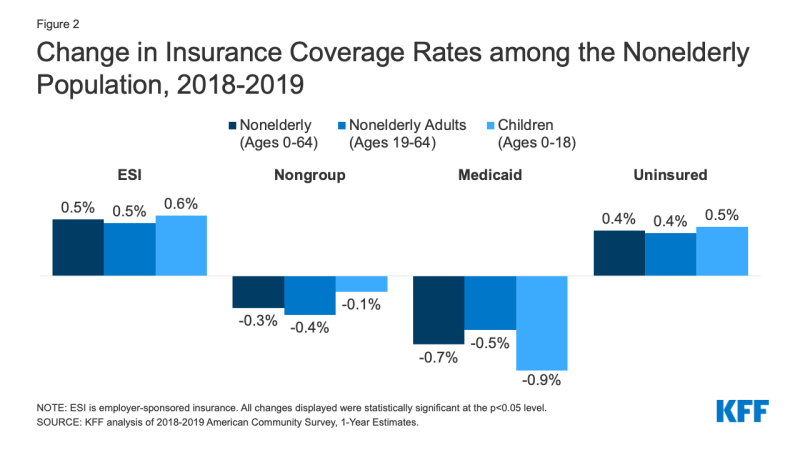
Figure ii: Alter in Insurance Coverage Rates amidst the Nonelderly Population, 2018-2019
- Hispanic people and Native Hawaiians and Other Pacific Islander people experienced the largest increases in the uninsured in 2019. The uninsured rate grew one percentage point, from 19.0% in 2018 to twenty.0% in 2019 for Hispanic people and 3.4 percentage points, from nine.iii% in 2018 to 12.7% in 2019 for Native Hawaiians and Pacific Islander people (Figure iii). While uninsured rates also increased for White and Asian people, the uninsured rates for Black and American Indian/Alaska Native people saw no significant alter.
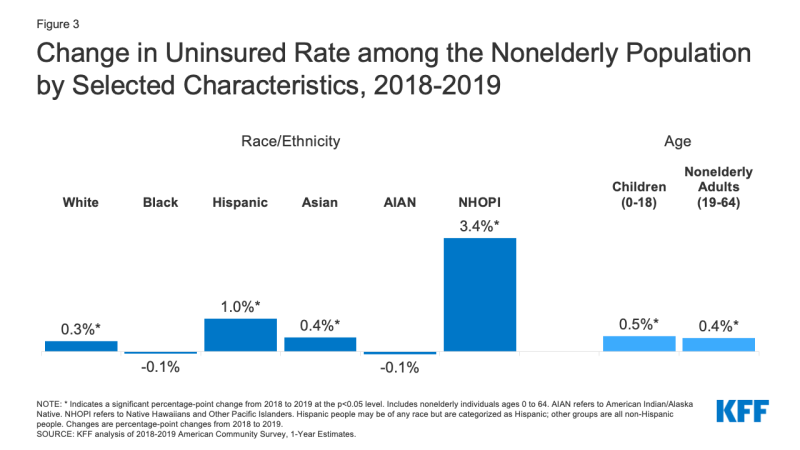
Figure 3: Change in Uninsured Rate amidst the Nonelderly Population by Selected Characteristics, 2018-2019
- Hispanic people deemed for over half (57%) of the increment in nonelderly uninsured individuals in 2019, representing over 612,000 individuals. Among these uninsured nonelderly Hispanic individuals, more than than a third (35%) were children.
- The number of uninsured children grew by over 327,000 from 2018 to 2019 and the uninsured charge per unit for children ticked up nearly 0.5 percentage points from simply nether 5.1% in 2018 to 5.six% in 2019 (Figure 3). While the uninsured charge per unit increased for children of all races and ethnicities, the increase was largest for Hispanic children, growing from eight.1% in 2018 to 9.2% in 2019.
- Changes in the number of uninsured individuals varied across states in 2019. A total of xiii states experienced increases in the number of nonelderly uninsured individuals, including nine Medicaid expansion states and four non-expansion states. Yet, the uninsured rate for the group of expansion states was near half that of non-expansion states (8.3% vs. 15.five%). Two states, California and Texas, accounted for 45% of the increase in the number of uninsured individuals from 2018 to 2019. Virginia was the just state to experience a statistically pregnant decrease in the number of uninsured in 2019; the state expanded its Medicaid plan that year (Appendix Table A).
Who are the uninsured?
Most people who are uninsured are nonelderly adults and in working families. Families with low incomes are more than likely to be uninsured. In general, people of color are more probable to be uninsured than White people. Reflecting geographic variation in income and the availability of public coverage, people who live in the S or West are more than probable to be uninsured. Near who are uninsured take been without coverage for long periods of fourth dimension. (See Appendix Tabular array B for detailed data on characteristics of the uninsured population.)
Cardinal Details:
- In 2019, over seven in ten of the uninsured (73.2%) had at to the lowest degree one full-time worker in their family and an additional 11.5% had a office-fourth dimension worker in their family (Figure 4).
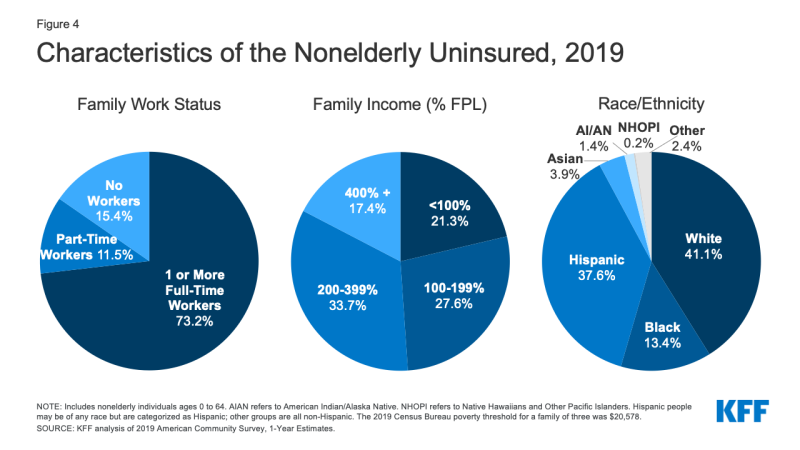
Figure 4: Characteristics of the Nonelderly Uninsured, 2019
- Individuals with income below 200% of the Federal Poverty Level (FPL)1 are at the highest take chances of being uninsured (Appendix Table B). In full, more than eight in x (82.half-dozen%) of uninsured people were in families with incomes below 400% of poverty in 2019 (Figure 4).
- Most (85.four%) of the uninsured are nonelderly adults. The uninsured rate amongst children was 5.6% in 2019, less than one-half the rate among nonelderly adults (12.9%), largely due to broader availability of Medicaid and CHIP coverage for children than for adults (Figure 5).

Effigy 5: Uninsured Rates amid the Nonelderly Population past Selected Characteristics, 2019
- While a plurality (41.ane%) of the uninsured are non-Hispanic White people, in general, people of color are at higher run a risk of existence uninsured than White people. People of colour make upward 43.ane% of the nonelderly U.S. population simply account for over half of the total nonelderly uninsured population (Figure 4). Hispanic, Blackness, American Indian/Alaska Native, and Native Hawaiians and Other Pacific Islander people all have significantly higher uninsured rates than White people (vii.8%) (Figure 5). Notwithstanding, similar in previous years, Asian people have the lowest uninsured charge per unit at seven.2%.
- Nearly of the uninsured (77.0%) are U.South. citizens and 23.0% are non-citizens. However, non-citizens are more likely than citizens to be uninsured. The uninsured rate for recent immigrants, those who have been in the U.S. for less than v years, was 29.6% in 2019, while the uninsured rate for immigrants who take lived in the US for more than 5 years was 36.three% (Appendix Tabular array B).
- Uninsured rates vary by state and by region; individuals living in non-expansion states are more likely to be uninsured (Figure five). Fifteen of the twenty states with the highest uninsured rates in 2019 were non-expansion states equally of that year (Figure 6 and Appendix Table A). Economic conditions, availability of employer-sponsored coverage, and demographics are other factors contributing to variation in uninsured rates beyond states.
- Nearly seven in ten (69.5%) of the nonelderly adults uninsured in 2019 accept been without coverage for more than than a year.two People who accept been without coverage for long periods may be particularly hard to reach in outreach and enrollment efforts.
Why are people uninsured?
Most of the nonelderly in the U.Southward. obtain wellness insurance through an employer, but not all workers are offered employer-sponsored coverage or, if offered, tin can afford their share of the premiums. Medicaid covers many low-income individuals; however, Medicaid eligibility for adults remains limited in some states. Additionally, renewal and other policies that get in harder for people to maintain Medicaid probable contributed to Medicaid enrollment declines. While financial assist for Marketplace coverage is bachelor for many moderate-income people, few people can afford to purchase private coverage without fiscal assistance. Some people who are eligible for coverage under the ACA may not know they tin get help and others may still find the cost of coverage prohibitive.
Key Details:
- Cost still poses a major bulwark to coverage for the uninsured. In 2019, 73.7% of uninsured nonelderly adults said they were uninsured because coverage is not affordable, making it the virtually common reason cited for being uninsured (Figure seven).
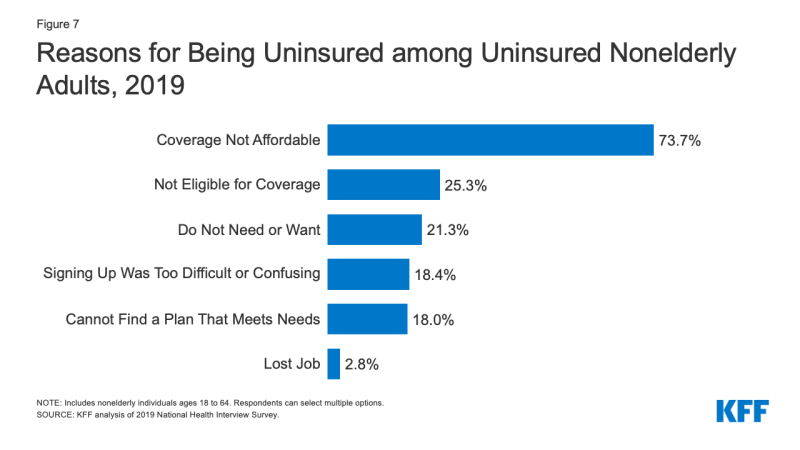
Figure 7: Reasons for Being Uninsured among Uninsured Nonelderly Adults, 2019
- Access to wellness coverage changes as a person'southward situation changes. In 2019, a quarter of uninsured nonelderly adults said they were uninsured considering they were not eligible for coverage, while 21.3% of uninsured nonelderly adults said they were uninsured because they did non need or want coverage (Effigy 7). Virtually one in five were uninsured considering they found signing up was too hard or confusing or they could not find a plan to meet their needs (eighteen.4% and 18.0%, respectively).3 Although only 2.8% of uninsured nonelderly adults reported existence uninsured due to losing their job in 2019, it is probable the number of people who have lost their job and job-based coverage increased in 2020 due to the coronavirus pandemic.
- Equally indicated above, non all workers take access to coverage through their job. In 2019, 72.five% of nonelderly uninsured workers worked for an employer that did not offer them health benefits.4 Amidst uninsured workers who are offered coverage by their employers, cost is often a bulwark to taking up the offer. From 2010 to 2020, total premiums for family unit coverage increased by 55%, and the worker's share increased by 40%, outpacing wage growth.5 Low-income families with employer-based coverage spend a significantly higher share of their income toward premiums and out-of-pocket medical expenses compared to those with income above 200% FPL.6
- Medicaid eligibility for adults varies across states and is sometimes limited. As of October 2020, 39 states including DC adopted the Medicaid expansion for adults under the ACA, although 34 states had implemented the expansion in 2019. In states that take not expanded Medicaid, eligibility for adults remains limited, with median eligibility level for parents at just 41% of poverty and adults without dependent children ineligible in most cases. Additionally, state renewal policies and periodic data matches tin make it difficult for people to maintain Medicaid coverage. Millions of poor uninsured adults fall into a "coverage gap" because they earn too much to qualify for Medicaid but not enough to qualify for Marketplace premium tax credits.
- While lawfully-nowadays immigrants nether 400% of poverty are eligible for Marketplace tax credits, merely those who have passed a five-year waiting period after receiving qualified immigration status can qualify for Medicaid. Changes to public accuse policy that allow federal officials to consider use of Medicaid for non-significant adults when determining whether to provide sure individuals a light-green bill of fare are likely contributing to coverage declines amid lawfully nowadays immigrants. Undocumented immigrants are ineligible for Medicaid or Market coverage.seven
- Though fiscal help is available to many of the remaining uninsured under the ACA, not everyone who is uninsured is eligible for complimentary or subsidized coverage. Nigh vi in 10 of the uninsured prior to the pandemic were eligible for financial assistance either through Medicaid or through subsidized marketplace coverage. Still, over four in 10 uninsured were outside the achieve of the ACA considering their state did non aggrandize Medicaid, their income was as well high to qualify for marketplace subsidies, or their immigration condition made them ineligible. Some uninsured who are eligible for help may not be aware of coverage options or may confront barriers to enrollment, and even with subsidies, market coverage may be unaffordable for some uninsured individuals. While outreach and enrollment assistance helps to facilitate both initial and ongoing enrollment in ACA coverage, these efforts face ongoing challenges due to funding cuts and high demand.
How does not having coverage affect health care access?
Wellness insurance makes a difference in whether and when people become necessary medical care, where they get their intendance, and ultimately, how good for you they are. Uninsured adults are far more than likely than those with insurance to postpone health care or forgo it altogether. The consequences can be astringent, especially when preventable atmospheric condition or chronic diseases go undetected.
Cardinal Details:
- Studies repeatedly demonstrate that the uninsured are less probable than those with insurance to receive preventive care and services for major health weather and chronic diseases.eight , nine , 10 , 11 More than ii in v (41.five%) nonelderly uninsured adults reported non seeing a doctor or health intendance professional in the by 12 months. Three in 10 (30.ii%) nonelderly adults without coverage said that they went without needed care in the by year because of cost compared to five.3% of adults with individual coverage and 9.v% of adults with public coverage. Office of the reason for poor access among the uninsured is that many (40.8%) do not have a regular identify to go when they are sick or need medical communication (Effigy 8).

Figure 8: Barriers to Health Care among Nonelderly Adults past Insurance Status, 2019
- More than one in x (10.two%) uninsured children went without needed care due to cost in 2019 compared to less than 1% of children with private insurance. Furthermore, one in five (20.0%) uninsured children had not seen a doctor in the past year compared to 3.5% for both children with public and private coverage (Figure 9).
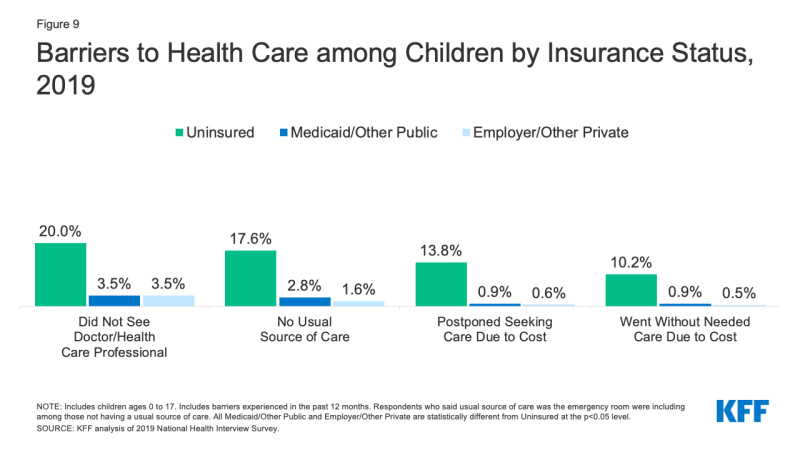
Effigy 9: Barriers to Health Intendance among Children by Insurance Status, 2019
- Many uninsured people practice not obtain the treatments their wellness care providers recommend for them because of the price of care. In 2019, uninsured nonelderly adults were more three times as likely as adults with private coverage to say that they delayed filling or did not become a needed prescription drug due to cost (19.8% vs. half-dozen.0%).12 And while insured and uninsured people who are injured or newly diagnosed with a chronic condition receive similar plans for follow-up care, people without wellness coverage are less probable than those with coverage to obtain all the recommended services.13 , xiv
- Because people without wellness coverage are less probable than those with insurance to have regular outpatient care, they are more likely to be hospitalized for avoidable health issues and to experience declines in their overall health. When they are hospitalized, uninsured people receive fewer diagnostic and therapeutic services and also have higher mortality rates than those with insurance.xv , 16 , 17 , 18 , 19
- Research demonstrates that gaining health insurance improves access to health care considerably and diminishes the agin effects of having been uninsured. A comprehensive review of research on the effects of the ACA Medicaid expansion finds that expansion led to positive effects on access to intendance, utilization of services, the affordability of care, and financial security among the depression-income population. Medicaid expansion is associated with increased early on-stage diagnosis rates for cancer, lower rates of cardiovascular bloodshed, and increased odds of tobacco cessation.xx , 21 , 22
- Public hospitals, customs clinics and wellness centers, and local providers that serve underserved communities provide a crucial health intendance safety internet for uninsured people. Yet, prophylactic net providers have limited resource and service capacity, and not all uninsured people have geographic access to a safety internet provider.23 , 24 , 25 Loftier uninsured rates likewise contribute to rural hospital closures, leaving individuals living in rural areas at an fifty-fifty greater disadvantage to accessing care.
What are the fiscal implications of being uninsured?
The uninsured often face unaffordable medical bills when they practice seek intendance. These bills can speedily translate into medical debt since most of the uninsured accept low or moderate incomes and have picayune, if any, savings.26 , 27
Primal Details:
- Those without insurance for an entire calendar year pay for nearly half of their care out-of-pocket.28 In addition, hospitals frequently charge uninsured patients much higher rates than those paid past private wellness insurers and public programs.29 , 30 , 31
- Uninsured nonelderly adults are much more likely than their insured counterparts to lack confidence in their power to afford usual medical costs and major medical expenses or emergencies. More than iii quarters (75.6%) of uninsured nonelderly adults say they are very or somewhat worried nigh paying medical bills if they become sick or take an accident, compared to 47.6% of adults with Medicaid/other public insurance and 46.1% of privately insured adults (Figure 10).
- Medical bills can put great strain on the uninsured and threaten their financial well-being. In 2019, nonelderly uninsured adults were nearly twice as likely every bit those with individual insurance to have issues paying medical bills (24.ane% vs. 11.6%; Effigy 10).32 Uninsured adults are as well more likely to confront negative consequences due to medical bills, such as using upwardly savings, having difficulty paying for necessities, borrowing money, or having medical bills sent to collections resulting in medical debt.33

Figure x: Problems Paying Medical Bills past Insurance Status, 2019
- Though the uninsured are typically billed for medical services they use, when they cannot pay these bills, the costs may become bad debt or uncompensated intendance for providers. Land, federal, and private funds defray some but not all of these costs. With the expansion of coverage under the ACA, providers are seeing reductions in uncompensated care costs, peculiarly in states that expanded Medicaid.
- Research suggests that gaining health coverage improves the affordability of intendance and financial security among the low-income population. Multiple studies of the ACA accept found larger declines in problem paying medical bills in expansion states relative to not-expansion states. A separate study found that, amidst those residing in areas with high shares of depression-income, uninsured individuals, Medicaid expansion significantly reduced the number of unpaid bills and the amount of debt sent to third-party collection agencies.
Decision
The number of people without health insurance grew for the 3rd twelvemonth in a row in 2019. Recent increases in the number of uninsured nonelderly individuals occurred amid a growing economy and earlier the economic upheaval from the coronavirus pandemic that has led to millions of people losing their jobs. In the wake of these record job losses, many people who accept lost income or their job-based coverage may qualify for expanded Medicaid and subsidized marketplace coverage established by the ACA. In fact, recent data indicate enrollment in both Medicaid and the Marketplaces has increased since the beginning of the pandemic. Notwithstanding, it is expected the number of people who are uninsured has increased further in 2020.
Drops in coverage amongst Hispanic people drove much of the increment in the overall uninsured rate in 2019. Changes to the Federal public charge policy may exist contributing to declines in Medicaid coverage among Hispanic adults and children, leading to the growing number without health coverage. These coverage losses as well come as COVID-nineteen has hit communities of color unduly difficult, leading to higher shares of cases, deaths, and hospitalizations among people of color. The lack of wellness coverage presents barriers to accessing needed care and may lead to worse health outcomes for those afflicted past the virus.
Even as the ACA coverage options provide an of import rubber cyberspace to people losing jobs during the pandemic, a Supreme Court ruling in California vs. Texas could take major furnishings on the unabridged health care organization. If the court invalidates the ACA, the coverage expansions that were cardinal to the police force would be eliminated and would event in millions of people losing health coverage. Such a large increase in the number of uninsured individuals would reverse the gains in access, utilization, and affordability of care and in addressing disparities achieved since the police was implemented. These coverage losses coming in the center of a public health pandemic could further jeopardize the health of those infected with COVID-19 and exacerbate disparities for vulnerable people of color.
baxterlingovensids1939.blogspot.com
Source: https://www.kff.org/uninsured/issue-brief/key-facts-about-the-uninsured-population/
0 Response to "Show Time and Again That Care"
Postar um comentário